



Content
- What Is Male Pattern Baldness?
- The Norwood Scale – How Male Pattern Hair Loss Progresses
- What Causes Male Pattern Baldness?
- At What Age Does Male Pattern Baldness Start?
- How Common Is Male Pattern Baldness?
- Symptoms and Early Signs
- How Male Pattern Baldness Is Diagnosed
- Latest Treatments for Male Pattern Baldness 2026
- Lifestyle Factors That Support Hair Health
- Prevention and Early Action
- FAQ – Male Pattern Baldness
What Is Male Pattern Baldness?
Male pattern baldness (medically known as androgenetic alopecia) is a hereditary condition in which hair follicles become sensitive to the hormone dihydrotestosterone (DHT). Over time the follicles shrink, producing thinner and shorter hairs until they eventually stop growing altogether. It follows a characteristic pattern: receding hairline at the temples and thinning at the crown, often leaving a horseshoe-shaped band of hair at the sides and back.
The Norwood Scale – How Male Pattern Hair Loss Progresses
The Norwood-Hamilton Scale is the standard classification system for male pattern hair loss. It ranges from Stage 1 (minimal recession) to Stage 7 (extensive baldness).
| Norwood Stage | Description | Typical Age of Noticeable Onset |
|---|---|---|
| Stage 1–2 | Slight recession at the temples | 18–30 years |
| Stage 3 | Deeper recession forming an M-shape | 25–35 years |
| Stage 4–5 | Significant thinning at the crown + frontal loss | 30–45 years |
| Stage 6–7 | Only a band of hair remains at the sides and back | 40+ years |
What Causes Male Pattern Baldness?
The primary driver is genetics combined with sensitivity to DHT, a byproduct of testosterone. Men with a family history are significantly more likely to develop male pattern hair loss. Other contributing factors include age, hormonal balance and chronic stress. For a deeper look at general triggers of hair loss, see our guide what causes hair loss.
At What Age Does Male Pattern Baldness Start?
Male pattern baldness can begin as early as the late teens. Approximately 16 % of men aged 18–29 already show signs. By age 35 roughly 65 % of men notice some degree of male pattern hair loss, and by age 50 that figure rises to around 85 %.
How Common Is Male Pattern Baldness?
Male pattern baldness accounts for approximately 95 % of all male hair loss cases. It is by far the most prevalent form of androgenetic alopecia in men and affects a large percentage of the male population worldwide.
Symptoms and Early Signs
Early warning signs of male pattern hair loss include a receding hairline, thinning at the crown, increased shedding in the shower or on the pillow, and a widening part. Many men first notice the change when their hairline starts moving backward or the crown becomes visibly thinner.
How Male Pattern Baldness Is Diagnosed
A dermatologist can usually diagnose male pattern baldness with a simple scalp examination and medical history. In some cases blood tests are done to rule out other causes such as thyroid issues or nutrient deficiencies.
Latest Treatments for Male Pattern Baldness 2026
The gold-standard medical treatments remain topical or oral minoxidil and finasteride (or dutasteride). Newer options in 2026 include clascoterone (topical androgen receptor inhibitor), PP405 (regenerative molecule targeting dormant follicles), and advanced oral minoxidil formulations. Hair transplantation with FUE remains the most permanent surgical solution for advanced stages.
| Treatment | How It Works | Expected Results (2026 data) | Best For |
|---|---|---|---|
| Finasteride / Dutasteride | Blocks DHT production | Strong slowing + regrowth in 80–90 % of men | Early to moderate stages |
| Minoxidil (topical/oral) | Increases blood flow to follicles | Visible thickening in 60–70 % within 6 months | All stages |
| Clascoterone (new 2026) | Topical androgen blocker | Promising Phase 3 results with fewer systemic side effects | Men seeking non-oral options |
| PP405 (regenerative) | Reactivates dormant follicles | Early data shows growth in previously inactive areas | Advanced thinning |
Lifestyle Factors That Support Hair Health
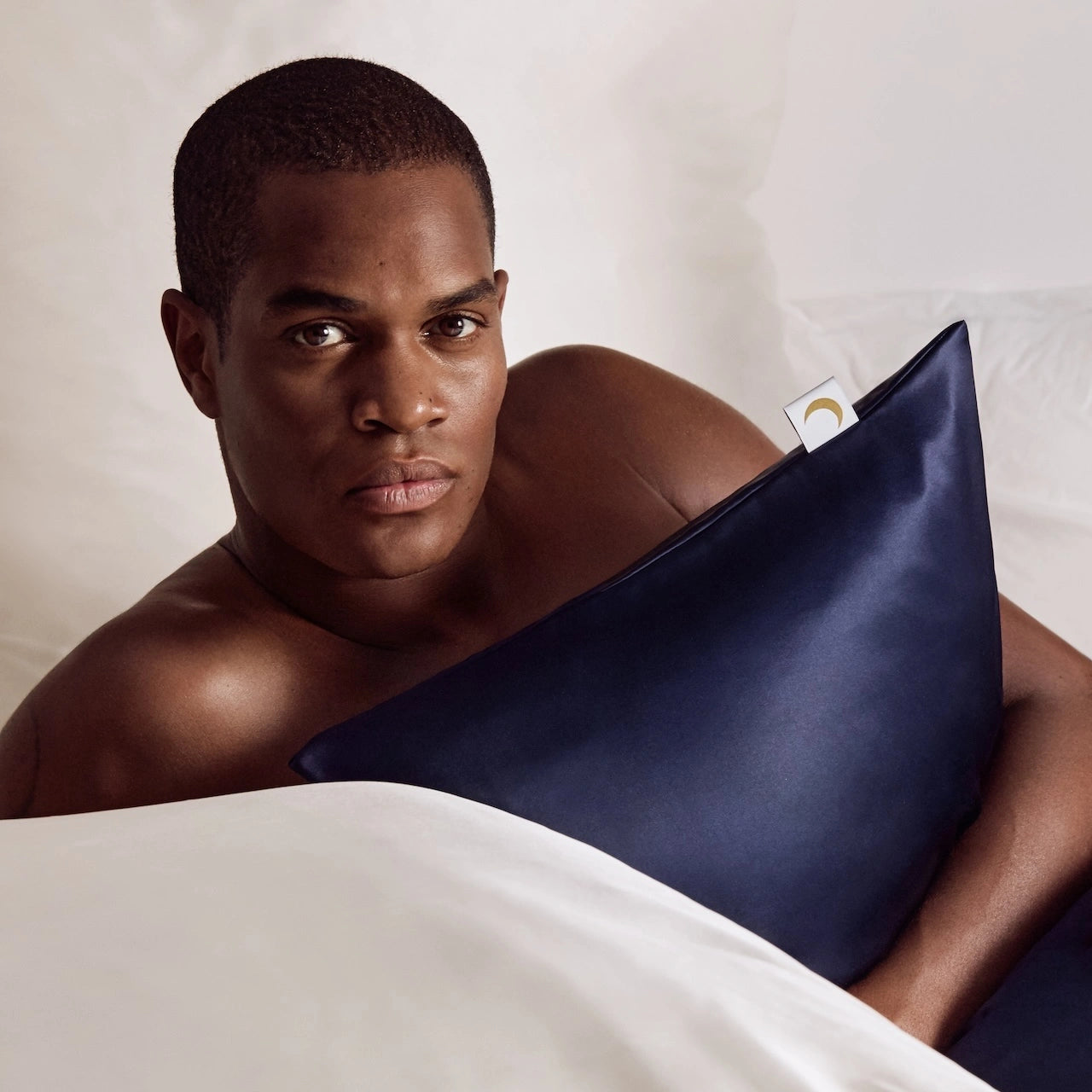
While medical treatments address the hormonal cause, lifestyle plays a major supporting role. Quality sleep and balanced cortisol levels help reduce additional stress on follicles. A high-quality silk pillowcase reduces friction, prevents hair breakage and supports deeper, more restorative sleep — an often-overlooked advantage for men dealing with male pattern hair loss. For more on the connection between stress hormones and hair, read our guides on cortisol and sleep and vitamins for hair growth.
Prevention and Early Action
The earlier you start addressing male pattern baldness, the better the outcome. Combining FDA-approved medications with consistent lifestyle habits (good sleep, stress management, gentle hair care) gives the best chance of keeping your hair longer.
FAQ – Male Pattern Baldness
What is the difference between male pattern baldness and other types of hair loss?
Male pattern baldness follows a predictable pattern caused by DHT sensitivity, whereas conditions like alopecia areata cause sudden circular patches. See our guide on Alopecia for more details.
At what age does male pattern baldness usually start?
It can begin in the late teens or early 20s. By age 35, about 65 % of men show some degree of loss.
Can male pattern hair loss be reversed?
Early stages can often be slowed or partially reversed with consistent treatment. Advanced baldness is harder to reverse completely.
Does stress make male pattern baldness worse?
Chronic stress can accelerate shedding and worsen the overall appearance of male pattern hair loss.
Are silk pillowcases helpful for male pattern baldness?
Yes — they reduce friction and breakage, keep hair smoother, and support better sleep, all of which help protect the hair you still have.
Sources
Journal of the American Academy of Dermatology (2025–2026)
Endotext / NCBI – Male Androgenetic Alopecia (updated 2025)
American Academy of Dermatology – 2026 Clinical Guidelines
Phase 3 data on clascoterone and PP405 (presented 2026)